
Writing with AI
Okay, it’s finally time . . . We’re going to talk about The Thing.
Artificial intelligence.
Dun, dun, dun!
Okay, let’s get serious.
Quick disclaimer that this blog post represents my thoughts in July 2026, and my mind might change tomorrow. With how quickly things are moving, who knows?
Using AI is a complicated and touchy matter, especially when it comes to the writing industry.
“It’s taking our jobs!”
“Art is becoming soulless!”
As an editor for self-published books, I get it. It’s affecting me too.
In general, I wouldn’t say I’m anti-AI. I think it has real potential to do some good in the world. I also think it could be a real threat to society (I’m not even talking about the environmental implications). And right now, when it comes to publishing, I think it’s leaning on the threat side.
But we can change that. We don’t have to use AI to parse every thought in our brain until we’re like the people in Wall-E. We don’t have to use it for every Google search. We don’t have to use it to write anything for us ever. Nope, not even an email. And we can still use it for good.
Let me amend my earlier statement: I am not anti-AI, but I am anti–AI art.
Real art can only be created by humans, and I strongly believe that. Art by AI is soulless because AI does not in fact have a soul. It is a computer system. Duh.
But I’ll concede that AI is really good at some things—recognizing patterns, analyzing the market, summarizing and transcribing, processing a lot of data. Those things are not art or writing.
Does that mean writers should never ever use AI? No, that’s not what I’m saying.
Does it mean any writers who use AI are soulless or evil? Also no.
Does it mean books written completely by AI are bad? . . . Maybe.
Wait, hear me out! I’m going to tell you how you can use AI to benefit your writing if you choose to do so. Of course, you don’t need AI for anything if you don’t want. But this blog post is for the people who want to use AI and don’t know how to do so well.
To Use or Not to Use AI: That Is the Question
You may have heard something to the effect of “AI won’t take jobs from humans, but humans who use AI will take jobs from humans who don’t use AI.”
And I tend to agree. Sometimes. But not when it comes to writing.
If you never use AI in your writing process ever ever ever, great! I see no problems there. I do not think you will be “left behind.”
If you do use AI in your writing process in strategic ways, that’s okay too! (I still have hangups about the environmental implications, so I can’t say it’s “great.” That’s an ethical decision for you though.)
Stealing Ideas
Let’s get into a big hangup with AI: Is it stealing ideas from humans?
One thing to keep in mind is that when AI generates words and sentences, it’s recycling things that have already been written. It only knows what we teach it (our ideas), which means it can’t create new ideas. We teach it by providing already written materials, which means it’s taking in other people’s books and writing, mixing it around, and spitting out something new.
But is that really considered stealing? That’s basically what we do as humans: read other people’s stuff, then come up with our own stuff based on that stuff. It’s not plagiarism, right? It’s just “inspired by” other writing. Aren’t all books just a rearranging of words of all other books? What about retellings and parodies? Humans do that, and that’s basically stealing ideas. (Don’t get me wrong, I love a Shakespeare retelling. She’s the Man, I’m looking at you.)
I don’t have the answers, folks. I have my own opinion, but it’s not cut and dry. I can’t write a blanket statement about when AI is stealing and when it’s not because I think it’s case by case—and person to person. This is something you have to consider and decide for yourself.
AI is powerful, and that comes with great responsibility. That’s why I think AI can either be the saving grace or downfall of humanity. (Let’s not be dramatic. It’s probably somewhere between. But still.) It must be used responsibly.
Using AI (If You Must)
Maybe you’ve been reading this thinking, I’m gonna use AI whether you like it or not. Honestly, thanks for reading this long! This next part’s for you!
If you do want to use AI in your writing, you can! And I have some ideas for how it can help you and influence your writing positively. First let’s start with the no-gos.
Ways AI Will Not Help
Research. Of any kind. AI will just make up studies and websites to confirm your claims. Or if you ask it to write a citation for an existing study that you (a human) found, it might make up information like the journal it was published in, the first names of the authors, or the URL. Seriously, don’t use AI for any research. It’s hopeless and makes a huge mess of the confirmed sources you have.
Outlining. This one might be effective (unlike research where it’s completely counterproductive), but I don’t think AI does it better than humans. Here’s what people like to do: Type in what they want their book to be about and let AI come up with the chapters and topics they’ll address. This is bad because now they have to come up with an equal amount of information for all those topics, which may result in some fluffy chapters without much substance because they don’t actually know that much about those topics. If you used your own brain for outlining, this wouldn’t happen because you’d only come up with topics you actually want to discuss as chapter topics, not what AI or anyone else says you should discuss.
AI might say there should be four chapters with topics A, B, C, and D. But with your wealth of knowledge and experience, you might decide A and B should be one chapter together, C should be two chapters, D isn’t actually that relevant, and new topics E and F should have their own chapters. We want your idea for how the book should be outlined because it’s unique to you. If we want to learn about your topic from a computer, we can. We’re reading your book because we want to learn about it the way you teach it. For help outlining, check out this blog post. If you’re worried about the book being convoluted and not making sense and so you want AI to help your self-help be more predictable and formulaic, that’s what editors are for! We can make sure the structure makes sense and is still human—like you.
That was an example for nonfiction, but it’s the same for fiction and memoirs. If you have AI outline the book for you, you won’t be able to focus on the scenes and parts you didn’t know you want to focus on because that’s diverging from the plan the computer laid out. If you make your own outline, you’ll be able to listen to the story and characters better and do what the story needs.
“Smoothing” your writing. This is the most common way writers use AI before hiring editors (according to what they’ve disclosed to me and what I’ve surmised from books my team and I have edited). This word—“smoothing”—is exactly what it does to your words. It takes out the variety and rhythms and uniqueness of your voice. It takes out any texture. Readers can tell when you use AI to smooth your writing because the cadence is robotic, the human voice is gone, and it feels sanitized. “But don’t we want it smooth, not choppy?” Not like that. It makes me think of that Spongebob episode where Spongebob doesn’t have holes anymore and he turns “normal” and goes around saying, “Hi, I’m normal” and freaking everyone out.
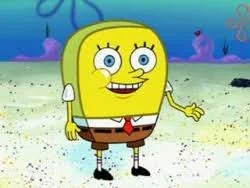
That’s what you’re doing to your writing when you smooth it with AI. You make it freaky and unnatural like this guy. This is not Spongebob. This is Spongebob by AI™.
Actually writing. Please. I’m begging you. Do not write an entire book with AI. There are several reasons.
First, there’s the whole debate of “Did you actually write it if AI generated it? Can you claim it as your work?” I don’t know the answer; just ponder it.
Then, there’s the argument that using AI to write is actually stealing other people’s work because AI learns how to write long-form content from other people’s work, like I already talked about. Again, I don’t know the answer to this ethical dilemma. Pool all the time you’re saving by using AI and ponder it.
Both of these problems apply even if the writing is really good. But I can tell you that it’s not, so then we have the problem that the book is just bad. Nonfiction or fiction, the underlying structure is bad.
The logic of self-help is looping and twisted, like M. C. Escher wrote it. It’s redundant and repetitive. It’s saying a lot of words without really saying anything at all. Which is really hard to make sense of as a reader or an editor (to then fix it for the reader). We are not politicians; we are writers. The goal is to be clear and concise.
The characters of fiction are flat and robotic (like the one writing them). They’re not relatable because they’re not humanlike (like the one reading them). The dialogue is unnatural (like how chatbots sound unnatural when you chat with them). Continuity between scenes is nonexistent. The overall message of the book—what is it? Who knows? Not AI. Not us either. The symbolism, motifs, themes—AI doesn’t know subtlety, so it can’t do this. There are endless reasons that the books written by AI are bad. These are just a few. I hope it’s enough to convince you.
But as I said, there are things AI is good at, and you can use them while writing a book.
Ways AI Can Help
Market insight. AI is great at analyzing patterns and big sets of data. It can track the publishing market; it can simplify stats and graphs and sales numbers. Then—this is important—you can decide what to do with that info. AI doesn’t know how to market to people well; that’s a human thing. But it does know which trends are doing well and which are not, which book covers are selling and which are not, which genres are on the rise and which are not. With that insight, you can market your book better.
Title generation. Think about social media algorithms. That’s AI, and it learns and adjusts to what you spend time looking at, what you like and comment on, what you scroll past quickly, etc. Now take all that information from every reader’s phone and interpret it for what buzzwords do well for book sales. Yeah, I can’t do that. But AI can! AI can recognize the patterns of which titles are performing and which are not. It knows which words are eye-catching and which are not. It knows what draws people in, in the most simplistic way. (Going back to marketing: It doesn’t know why people are drawn in by these things; that’s marketing, and that’s for humans. But it does know what draws people in.) What I normally suggest if people are struggling to come up with a title for their book and want to use AI is to tell AI what your book is about, the tone you’re going for, and who your reader is, then ask for ten title and subtitle suggestions that would sell in the current market. From there, you can come up with your own title by combining some of its suggestions. Note that this will not be a clever title, and this doesn’t work when there are themes or motifs you want the title to reflect, but it’s a good starting point for self-help specifically.
Citations. If you have all the information necessary for a citation and just need it written in the correct format (order of information, proper punctuation between each one, etc.), AI can do that. If you have APA citations for everything and need them changed to Chicago format, AI is your guy. But you will need to supervise because AI really goes off the rails with this stuff sometimes.
Okay, I’ll step down off my soapbox and leave you with some final thoughts.
If you’re trying to write to create art, AI won’t do that for you.
If you’re not trying to create art in the first place, you’re just trying to teach something, AI can’t do that for you either.
If we take out all the ethical implications, the environmental effects, any emotional hangups, blah blah blah, AI is not going to produce good long-form content. An email? Fine, whatever. A book? It won’t. As much as you want it to work, it’s not going to produce something worthwhile. I wanted to say, “It’s just not at that level yet,” but I don’t think it will ever be at that level.
What makes writing good is the heart of the writer. And the writer, AI, doesn’t have a heart. It hasn’t learned things the hard way or experienced loss or love or disappointment or betrayal. It hasn’t been embarrassed or afraid for its life. It hasn’t felt relief or physical pain or pride for a loved one. It hasn’t experienced mortality, gratitude for another day, or fear of death.
I feel like this is the end of the Barbie movie where Barbie decides to be human so she can experience all the good andthe bad. She’s tired of the repetitive, sanitized simulation of a life.
Readers don’t want that. They want you and your experiences. That’s why they’re reading your book. Don’t make a Barbie Land book with AI. Choose human.
